
Personal Essay
Before the Story
Custodia Umbrarum did not begin as a story. It began as the clawing persistence of thoughts and images that would not release their grip. The kind that drags you to bed at night and is there, patient and alert, when you open your eyes in the morning.
There was no image at first, only the pain of something unfinished pressing for attention. The kind of pain that is not urgent or inspirational, just enduring and relentless. The kind of thing that could have walked me all the way down to my grave if I kept refusing to look at it.
It was the slow accumulation of weight that begins to curl up inside you when something refuses to be said out loud, but refuses to leave you too.
For a long time, I believed healing required illumination. That pain had to be exposed, translated, redeemed and held accountable. Much of my earlier work comes from that instinct. I learned how to sit with difficult material, how to turn experience into symbol, how to make something beautiful out of what had once been corrosive.
This piece would not comply.
This time the pain was too deep. Foundational. Primal.
What surfaced instead was a question I could not soften. What happens when pain is not meant to be resolved, only carried?
The figure at the center of Custodia Umbrarum is not a hero. She does not triumph. She does not purify the darkness or escape it.
She remains inside a system that functions because she does.
Others sleep because she stays awake. Others are spared because she absorbs what they will not.
The shadows in this work are not monsters. They are dependent.
They gather where pain has been deferred, where fear has been inherited rather than faced. They do not charge or attack. They wait.
Their power does not come from cruelty, but from neglect.
I was not interested in telling a story about conquest. Clear villains would have made this easier, and dishonest.
What disturbed me was the quieter truth: much of what we call darkness survives because someone else is doing the work of holding it together.
The child in the Keeper’s arms bears the greatest weight.
Small enough to appear harmless.
Familiar enough to invite care.
Old enough to know exactly where to feed.
Love, in this work, is not salvific.
It is consumable.
This piece does not offer relief. It does not promise transformation. It has no interest in a redemption arc.
It is concerned with ethical exhaustion. With the cost of systems that function because someone else absorbs their damage. With the quiet agreement that allows everyone else to remain untouched.
The story came after the image.
Language arrived as excavation, not invention. The text does not explain the work. It listens to it.
What remains unresolved is deliberate. Time can pass without healing. Stillness can exist without peace.
If there is courage here, it is not in bearing the weight, but in refusing to lie about its permanence.
The Story
Custodia Umbrarum
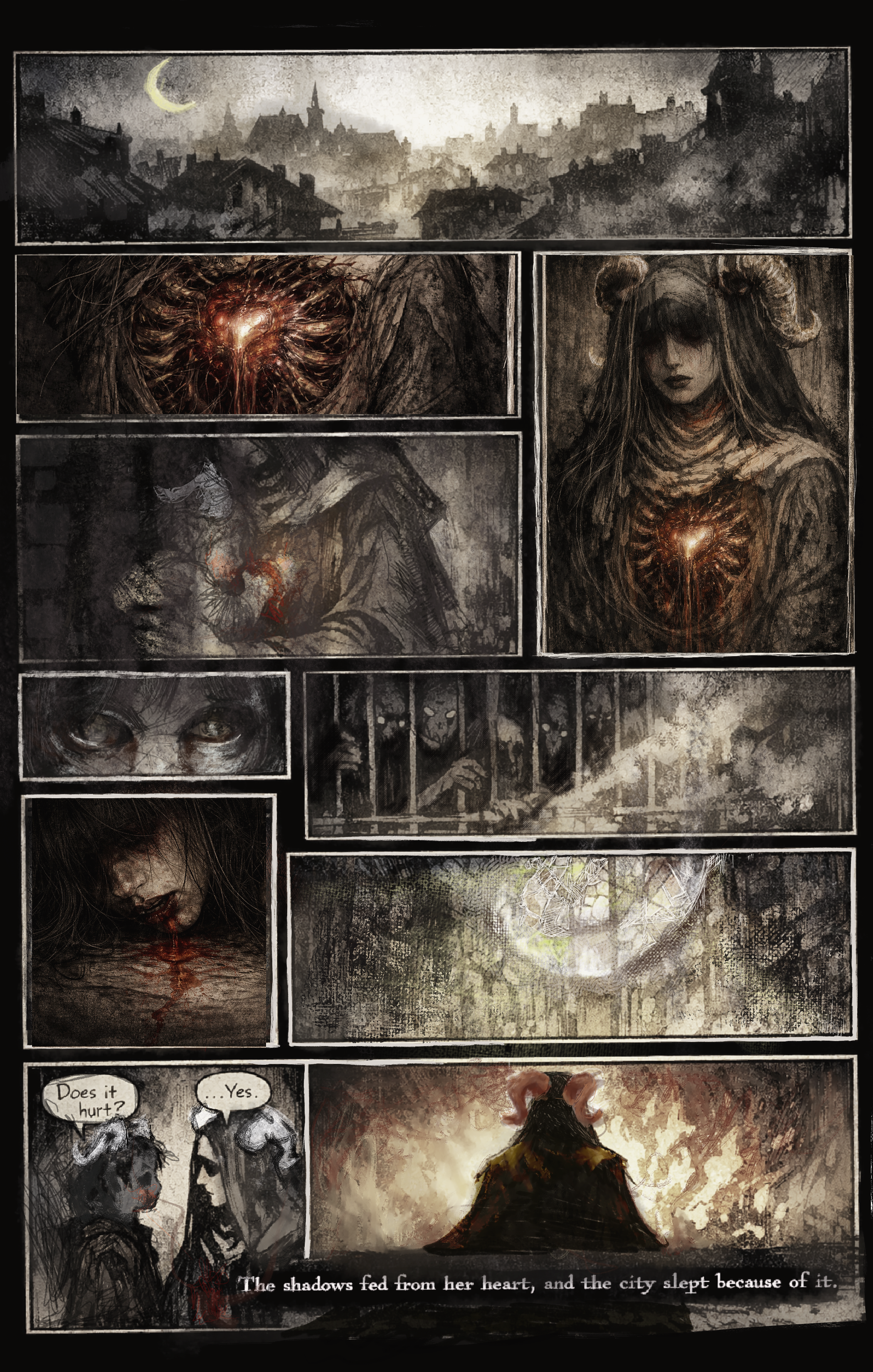
The child fed from her heart, and the city slept because of it.
Night settled thick and airless, sliding into streets and windows alike, dragging the city under. The air stank of burnt copper and soot. In narrow alleys, shadows gathered, not cast by moonlight, but born from every nightmare that had ever made a home in a man’s heart.
They did not roam.
They waited.
She stood at the center of it all, wrapped in a tattered habit that clung to her like old regret. The cloth had once been white. She remembered that vaguely, the way one remembers a promise made before understanding its cost.
Now it held smoke and residue, vows rewritten not by faith, but by endurance.
They called her the Keeper of Shadows, though no one spoke the name aloud. Names give things edges, and this place had learned to survive without them.
She carried no lantern. No torch. Only the dull glow leaking from her cracked heart, illuminating the darkness pressed against her like a second skin.
It was not holy. It was not a promise. It was simply what remained.
In her arms, she cradled the child, or something that resembled one closely enough to pass.
Its eyes glimmered wet and ancient. Tiny fangs pressed into the thinning place of her heart with practiced hunger. She felt every bite. Her body had learned not to flinch.
Behind her, the bars held the others. Some leaned forward in recognition. Others turned away in relief.
Hunger knows its own.
Above, stained glass fractured the light, casting beauty without intention. Saints had once occupied that space. Now only color endured.
“You’re not afraid of them,” a voice said.
A child stood apart, watching.
“Does it hurt?” she asked.
“Yes,” the Keeper said. “It always does.”
“Then why do you do it?”
The Keeper did not look away.
“Because the shadows do not need another jailor,” she said. “They need someone who will not look away.”
The fire burned behind her.
It always had.
The darkness did not advance.